A Fractional Raster–Vector Clipping Operator for Boundary-Consistent Multi-Scale Spatial Analysis
Younes Hamdani
Section for Ecoinformatics & Biodiversity, Department of Biology, Aarhus University, Aarhus, Denmark
Center for Landscape Research in Sustainable Agricultural Futures (Land-CRAFT), Aarhus University, Aarhus, Denmark
Center for Sustainable Landscapes Under Global Change (SustainScapes), Department of Biology, Aarhus University, Aarhus, Denmark
Urs Albert Treier
Section for Ecoinformatics & Biodiversity, Department of Biology, Aarhus University, Aarhus, Denmark
Center for Landscape Research in Sustainable Agricultural Futures (Land-CRAFT), Aarhus University, Aarhus, Denmark
Center for Sustainable Landscapes Under Global Change (SustainScapes), Department of Biology, Aarhus University, Aarhus, Denmark
Signe Normand
Section for Ecoinformatics & Biodiversity, Department of Biology, Aarhus University, Aarhus, Denmark
Center for Landscape Research in Sustainable Agricultural Futures (Land-CRAFT), Aarhus University, Aarhus, Denmark
Center for Sustainable Landscapes Under Global Change (SustainScapes), Department of Biology, Aarhus University, Aarhus, Denmark
Related authors
No articles found.
Dirk Nikolaus Karger, Michael P. Nobis, Signe Normand, Catherine H. Graham, and Niklaus E. Zimmermann
Clim. Past, 19, 439–456, https://doi.org/10.5194/cp-19-439-2023, https://doi.org/10.5194/cp-19-439-2023, 2023
Short summary
Short summary
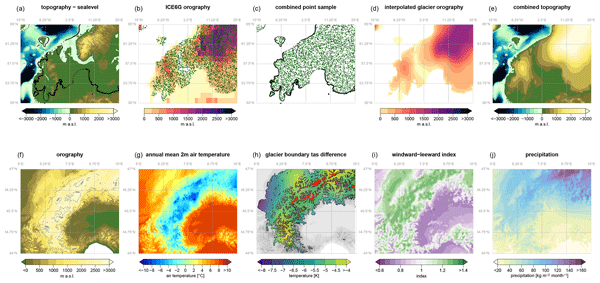
Here we present global monthly climate time series for air temperature and precipitation at 1 km resolution for the last 21 000 years. The topography at all time steps is created by combining high-resolution information on glacial cover from current and Last Glacial Maximum glacier databases with the interpolation of an ice sheet model and a coupling to mean annual temperatures from a global circulation model.
Jakob J. Assmann, Jesper E. Moeslund, Urs A. Treier, and Signe Normand
Earth Syst. Sci. Data, 14, 823–844, https://doi.org/10.5194/essd-14-823-2022, https://doi.org/10.5194/essd-14-823-2022, 2022
Short summary
Short summary
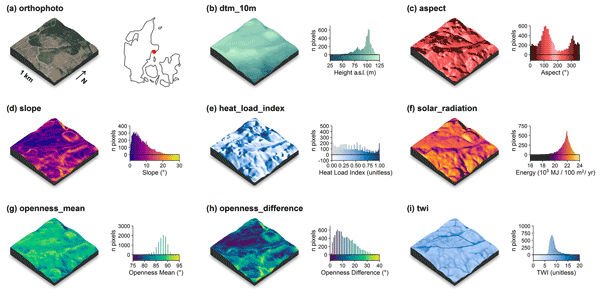
In 2014 and 2015, the Danish government scanned the whole of Denmark using laser scanners on planes. The information can help biologists learn more about Denmark's natural environment. To make it easier to access the outputs from the scan, we divided the country into 10 m x 10 m squares and summed up the information most relevant to biologists for each square. The result is a set of 70 maps describing the three-dimensional architecture of the Danish landscape and vegetation.